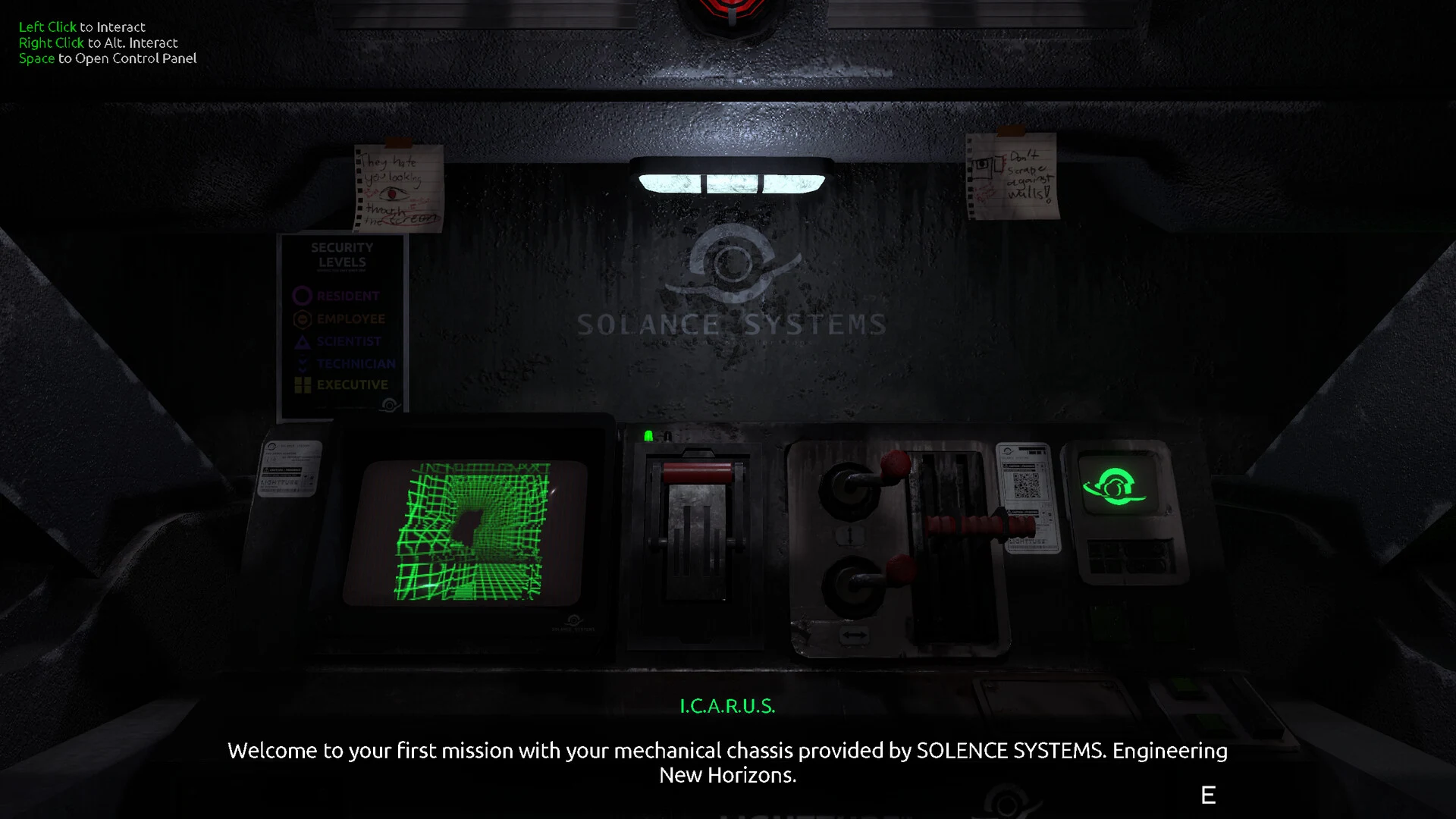
- FEED MY MECH ending explained: The finale is best read through its Signals, colony evidence, and machine-infection clues.
- Core mystery: The underground colony and its abandoned systems connect the pilot’s survival problem to a larger corporate failure.
- Important distinction: Available references confirm the story themes, but not a verified list of named endings or exact branch requirements.
- Best approach: Preserve a save before the final sequence and investigate optional clues before selecting a late-game route.
- Spoiler warning: The sections below discuss the game’s central mystery, ending interpretation, and possible completion strategy.
FEED MY MECH Ending Explained: What the Finale Establishes
FEED MY MECH ending explained begins with the game’s central perspective: the player is not freely exploring an open world, but operating from inside a vulnerable machine. The cockpit, monitor screens, map, scanner, power display, and restricted visibility all shape how the story is understood.
The player’s knowledge is deliberately incomplete. Information arrives through environmental clues, Signals, damaged equipment, route changes, and encounters with infected mechanical threats. This makes the ending less about a single exposition scene and more about connecting evidence gathered across the underground colony.
The strongest confirmed story elements are the following:
| Story element | What it establishes | Why it matters at the ending |
|---|---|---|
| Underground colony | The player is exploring an isolated, abandoned human facility | The setting preserves the consequences of an earlier collapse |
| Signals | The expedition includes a deliberate recovery or investigation objective | Signals function as narrative breadcrumbs, not just mission items |
| Infected machines | Mechanical systems have become dangerous or corrupted | The threat is connected to the colony’s technological failure |
| Solance Systems | A named organization is tied to the wider mystery | Corporate responsibility becomes a major interpretive question |
| Cockpit viewpoint | The player receives information indirectly | The ending leaves room for interpretation and uncertainty |
The ending’s emotional effect comes from the contrast between industrial machinery and human absence. The colony is filled with systems designed to support life, movement, communication, or extraction, yet the player encounters the remains of a place that no longer functions as intended.
Treat every late-game machine interaction as part of the explanation. A device, route, or Signal that seems optional may clarify what happened before the player arrived, even when it does not visibly change the final sequence.
The role of the Signals
Signals should be read as fragments of a larger communication or recovery trail. The available game information confirms that Signals are a central collectible and progression concept, but it does not verify a complete transcript or a fixed explanation for every Signal.
That uncertainty appears intentional. The player is placed in the role of an investigator who must reconstruct events from incomplete records. The Signals therefore support three layers of meaning:
- They identify places where the colony’s history remains accessible.
- They connect the player’s current expedition to earlier activity.
- They suggest that the final truth cannot be understood from the main route alone.
The role of Solance Systems
Solance Systems is important because it gives the colony’s mystery an institutional dimension. Without that name, the setting could be interpreted as a generic abandoned facility. With it, the player can ask more specific questions about ownership, experimentation, maintenance, responsibility, and concealment.
The story does not need to state every answer directly. The company name encourages the player to compare official-looking infrastructure with the hostile conditions found inside the colony. That contrast is one of the game’s most effective pieces of environmental storytelling.
How to Interpret the Colony and Infected Machines
The colony is not only a backdrop for exploration. Its layout supports the narrative by controlling what the player can see, when routes become available, and how much context is revealed before a dangerous encounter.
The game’s progression loop generally follows a consistent pattern: prepare the mech, locate an objective, inspect equipment, operate a device, confirm that the environment changed, and continue into a new section. This structure makes each opened route feel like both a gameplay solution and a story reveal.
| Evidence category | Player observation | Narrative implication |
|---|---|---|
| Damaged infrastructure | Systems remain present but no longer serve their original purpose | The collapse was not a simple act of abandonment |
| Restricted visibility | Important information is hidden beyond the cockpit’s immediate view | The player is never given total certainty |
| Infected machines | Familiar technology becomes a source of danger | The mechanical disaster affects both tools and threats |
| Side passages | Optional routes contain additional context | The main ending may not represent the whole story |
| Power pressure | Exploration requires careful resource decisions | Survival limits how much truth the player can investigate |
Are the infected machines the original cause?
The available material does not confirm that infected machines caused the colony’s collapse. A safer interpretation is that they are evidence of a broader failure already underway.
They may represent corrupted systems, abandoned technology operating without human oversight, or a later consequence of the same event that emptied the colony. Their presence makes the environment dangerous, but danger alone does not prove that they are the origin of the disaster.
This distinction matters when interpreting the finale. The player should avoid reducing the mystery to “the machines became hostile.” The more important question is why the machines were left in that condition and what the colony’s operators knew before the player arrived.
Why the cockpit perspective matters
The cockpit creates a controlled information flow. The player sees through screens and instruments rather than directly observing the colony as an ordinary character. That design supports the game’s horror because the machine is both protection and limitation.
The mech provides distance from threats, but it also creates dependence on:
- Power readings
- Scanner feedback
- Navigation information
- Interaction prompts
- Environmental silhouettes
- Routes that may change after equipment is activated
This limited perspective also explains why the ending can feel unresolved. The player is not receiving an objective historical report. They are assembling a conclusion from damaged evidence while trying to keep the machine operational.
The current reference material does not verify exact enemy origins, a complete Signal transcript, or a canonical corporate confession. Interpret those elements as supported theories rather than confirmed facts.
Comparison of the main interpretations
Corporate Failure
Solance Systems may have created or managed the colony’s infrastructure, then failed to protect its personnel or disclose what happened.
Technological Corruption
The infected machines may reflect a system-wide breakdown in control, maintenance, or operating directives.
Buried Evidence
The colony may be designed around hidden records, with the player uncovering only fragments of a much larger incident.
These interpretations can overlap. A corporate failure could have caused technological corruption, while the hidden evidence explains why the player receives incomplete information. The game’s atmosphere is strongest when all three possibilities remain connected.
Ending Route and Completion Strategy
The safest way to approach the ending is to separate the first completion from the investigation run. On the first run, prioritize survival and the main objective. On a later pass, use your knowledge of the map and progression chain to inspect optional locations and unresolved interactions.
The available references describe an ending guide structure built around spoiler-free preparation, key-choice review, ending comparison, and post-completion cleanup. They do not verify a fixed number of endings or provide confirmed names for each outcome.
Complete the main exploration objectives
Follow the primary route through the underground colony and keep the mech operational. Use the cockpit displays, scanner, and navigation interface to identify the next practical objective instead of wandering without a plan.
Investigate optional evidence before the finale
Revisit side passages, unusual machinery, abandoned structures, and locations that remain accessible after a major route opens. Optional clues may improve your understanding of the final decision.
Create a separate save before the final sequence
Preserve the latest safe save before committing to an irreversible late-game interaction. Avoid overwriting that slot while testing a choice or route.
Record the choice and immediate result
Change one decision at a time on repeat runs. Note the selected interaction, the route taken, and the final information revealed so you can compare outcomes accurately.
Return for missed discoveries
After seeing one outcome, revisit earlier areas and inspect unresolved objects. Use the completed run as a reference for identifying clues that were easy to overlook during the first expedition.
| Phase | Primary goal | Recommended behavior |
|---|---|---|
| First run | Reach the finale safely | Follow objectives and conserve power |
| Evidence run | Find optional story clues | Search side routes and inspect unusual objects |
| Branch run | Compare late-game outcomes | Reload the preserved save and alter one choice |
| Cleanup run | Find missed content | Revisit earlier areas after learning the progression chain |
Make your backup save before the last clearly irreversible interaction, not after it. This gives you room to test a route without repeating the full colony expedition.
What to check before committing
Use this short preparation list before entering the final area:
Before the Final Sequence:
- Finish all currently accessible main objectives
- Inspect optional machinery and unusual environmental clues
- Review unresolved Signals and side-route discoveries
- Confirm the mech has enough power for the intended route
- Create a separate save before the final interaction
The goal is not to force every possible interpretation into one playthrough. Instead, preserve enough information to compare the game’s outcomes without confusing a missed clue with a genuine branch difference.
What the Ending Means for the Player
The ending works best as a confrontation with incomplete knowledge. The player enters the colony expecting a practical mission—explore, recover Signals, operate equipment, and survive—but gradually discovers that the mission is connected to a history the colony has failed to preserve clearly.
The mech is therefore more than a vehicle. It represents the player’s dependence on systems built by the same technological culture that produced the abandoned colony. Every display that helps the player survive also reminds them that they are trusting damaged machinery in an environment where machinery has already become dangerous.
| Theme | Surface-level reading | Deeper reading |
|---|---|---|
| Survival | Keep power and machine condition stable | Human survival depends on unreliable technology |
| Signals | Recover mission-related items | Reconstruct a history that was not preserved openly |
| Infected machines | Avoid hostile mechanical threats | Technology can continue operating after responsibility disappears |
| Solance Systems | Background company name | Institutional decisions may explain the colony’s condition |
| Final choice | Select a route or interaction | Decide how much evidence to trust and what conclusion to accept |
Is the ending meant to be fully resolved?
The available material supports an intentionally atmospheric reading rather than a fully documented timeline. The game emphasizes exploration, limited visibility, Signals, environmental clues, and the mystery surrounding Solance Systems. Those elements encourage the player to connect evidence rather than wait for every question to receive a direct answer.
That does not mean the ending has no meaning. Its central message is clearer than its exact chronology: the colony’s systems outlasted the people and institutions that were supposed to control them, leaving the player to navigate the consequences.
Why optional exploration matters
Optional exploration is valuable because horror depends on contrast. The critical route shows what the player must do to progress. Side areas show what the colony was like before its systems failed, or at least provide additional evidence about that failure.
A discovery may not change the final scene while still changing the player’s interpretation of it. This is especially important for environmental clues, repeated symbols, damaged machinery, and messages that appear unrelated to the immediate objective.
For a story-focused completion, prioritize discoveries that:
- Explain why a location was built.
- Connect a machine to a larger system.
- Reveal a contradiction between official function and present condition.
- Clarify the purpose of a Signal.
- Add context to the infected mechanical threats.
The most reliable reading is that FEED MY MECH presents a technological and institutional collapse through fragmented evidence. The ending is less a single answer than the final point in the player’s reconstruction of that collapse.
FAQ: FEED MY MECH Ending Explained
Q: What is the main idea behind the FEED MY MECH ending?
The ending connects the abandoned underground colony, recovered Signals, infected machines, and Solance Systems into a broader mystery about technological and institutional failure.
Q: How many endings does FEED MY MECH have?
The supplied reference material does not verify a specific number of named endings. Use a preserved save and compare late-game choices rather than relying on an unconfirmed ending count.
Q: Do the Signals directly change the ending?
Signals are confirmed as an important exploration and story element, but the available information does not establish that every Signal directly changes the final outcome. They primarily help build context.
Q: Should I explore optional areas before finishing the game?
Yes. Optional areas, unusual machinery, and environmental clues can improve your understanding of the colony and may help identify missed ending-related content.
The official FEED MY MECH Steam store page is the best place to verify current game information. The developer’s TheManiacMartian page is also useful for official project details and updates.